
A hair extension specialist is a stylist with method-specific training and a working record in the extension methods they install. Here is the uncomfortable truth about hair extensions: the hair is rarely the problem. Good Remy and Slavic hair is available to any salon with an account. What separates an install you forget you are wearing from one that shows at the shoulder, pulls at the temple and sheds by month three is the person who planned it. You are not shopping for extensions. You are shopping for an extension specialist.
That is a harder search, because every stylist with a tape-in kit can list “extensions” on a menu, and a good Instagram grid hides more than it shows. This guide gives you a working definition of a specialist, the ten questions that separate one from a generalist in a single conversation, the six red flags that should end the conversation, and the three things to look for in a portfolio that most people never check. It is written from the chair at CK Studio Salon in Skokie, where extensions are a consultation-first service and the answer to “which method?” is sometimes “not yet.”
Choosing an Extension Specialist, Distilled
- A state cosmetology license is the floor. Extension training is separate: certification formats and duration vary by brand and method, and a specialist keeps taking them.
- Ask about density, grams, placement and removal. A specialist answers in specifics; a generalist answers in adjectives.
- Insist on the “under the hood” photo: the attachment side of a finished install, hair lifted. Front-facing results prove nothing.
- Six red flags: quoting by phone or DM, one method for everyone, vague about hair origin, no attachment photos, prices far under market, no removal plan.
- Your hair’s safety is a weight problem. Too many grams on too little density is how extensions damage hair, and only a hands-in-the-hair consultation can measure it.
What Makes Someone a Hair Extension Specialist?
Start with what the license covers. In Illinois, a cosmetology license requires 1,500 hours of schooling and a state exam, per the Illinois Department of Financial and Professional Regulation. Those hours teach cutting, coloring and chemistry. They do not teach how many grams of keratin-bonded hair a fine-haired client’s nape can carry for five months without stress. That knowledge comes from method-specific education and repetition.
Method training is real and measurable. Great Lengths, one of the oldest bonding systems, was featured in a 2019 American Salon article describing a three-day certification and an online tape course. Formats vary by brand and method; ask which current training the stylist has completed for the method being recommended.
Then there is frequency. A stylist who installs extensions twice a year is practicing on you. A specialist installs, moves up and removes extensions every week, which is the only way to build the file of how different densities, textures and color histories behave over months. Finally, a specialist offers choices. Our own menu is deliberately narrow (Tape-In, I-Tip and K-Tip, the three methods we can stand behind), but it is three methods, chosen per client, not one method sold to everyone.
The Ten Questions to Ask Before You Book Anywhere
You can ask these on the phone before the consultation, and you should ask the rest at the chair. Listen less for the answers themselves than for whether the answers are specific.
- Which methods do you install, and how would you choose between them for my hair? A specialist explains the trade-offs (the flattest and most discreet option for fine hair, strand-by-strand bonds for longest wear, a bead-based option with no heat or glue) and says the choice depends on your density and routine. A generalist names one method and says it is the best.
- How do you decide how much hair I need? The answer should include the word “density” and the word “grams”. Weight is calculated from what your natural hair can carry invisibly and safely, not from how much length you want.
- Where does your hair come from, and is it Remy? Remy means the cuticles run in one direction, which helps it resist tangling; the label alone does not guarantee tangle-free wear. Ask about sourcing, processing and suitability for your hair. “Good quality, don’t worry” is not an answer.
- How will you match my color? Look for matching to your root, mid-length and ends in natural light, and custom toning of the extension hair before install day. Hair pulled off a shelf in one shade will sit inside your dimension as a flat stripe.
- Where will the attachments sit when my hair is up? A specialist maps placement to your part and hairline and wear-tests a high ponytail before you leave. If the answer is “standard rows”, they will show.
- What is the full first-year cost? Install, the hair itself, every maintenance visit and the eventual removal. A specialist builds this number for you; many salons quote only the first appointment.
- How often is maintenance, and what happens if I am late? You want a calendar: roughly every 6–8 weeks for tape-in and I-tip move-ups, with keratin bonds wearing 4–6 months between full reinstalls. You also want the honest consequence of skipping (matting at the root, tension on your natural hair).
- Can I see photos of a client with hair like mine, including the attachment side? Not a stranger’s thick-haired transformation. Someone with your density, in the “under the hood” view.
- How are they removed, and do you remove extensions installed elsewhere? Removal is a skill. A specialist describes the process (the manufacturer’s approved release process for the installed system, without pulling) and quotes removal of someone else’s work separately after seeing it.
- Will you tell me if extensions are not right for my hair right now? The best specialists say no to some clients: hair too compromised to carry weight, too short for attachments to hide, scalp conditions that need a dermatologist first. If no one has ever been turned away, the consultation is a sales meeting.
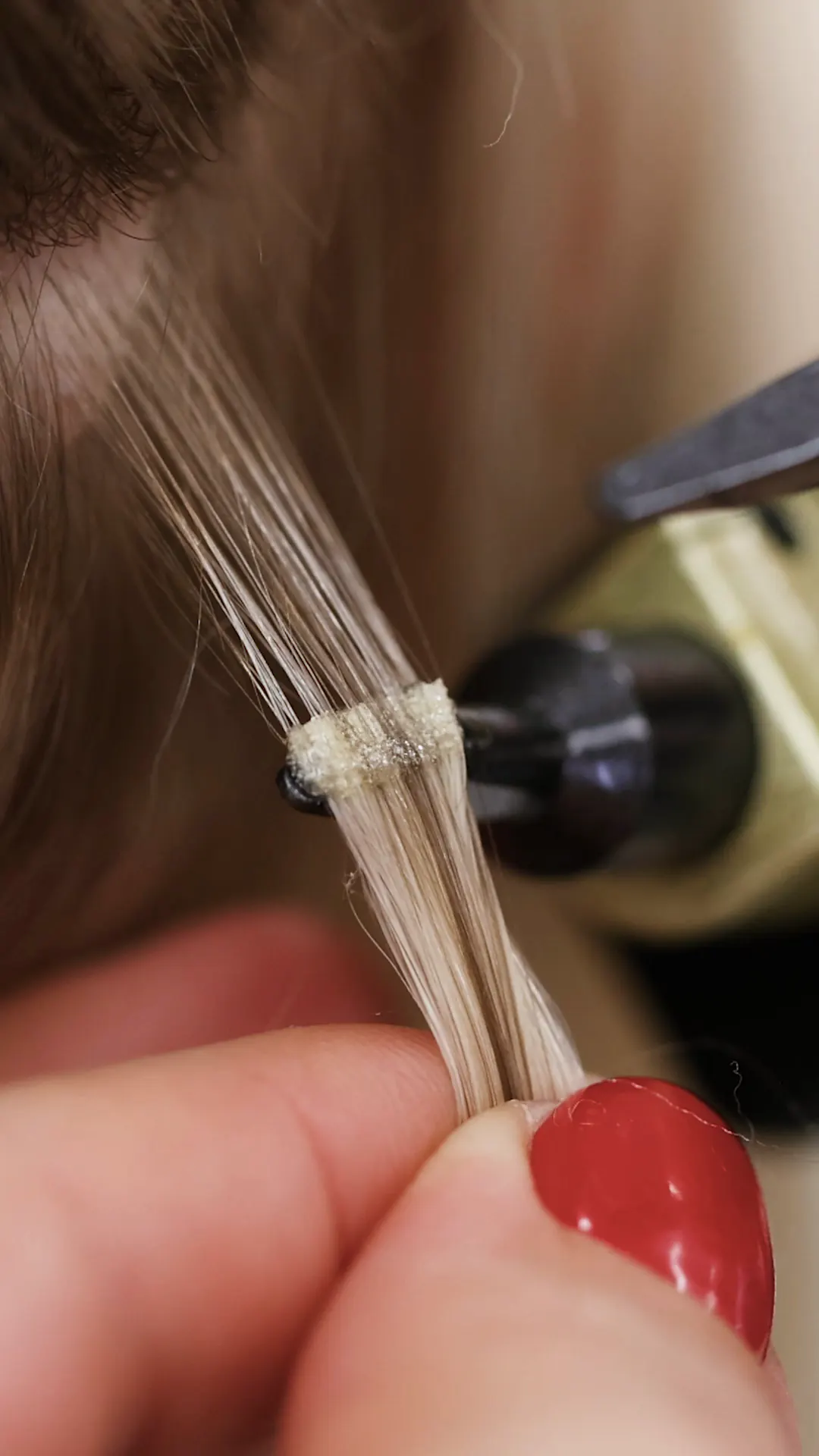
The Science: Why This Is a Safety Question, Not a Beauty Question
Extensions add weight to natural hair and anchor it at the follicle. Matching weight to density reduces strain, but it does not remove the risk of traction-related hair loss. When the weight is wrong, or the attachment is placed too tight or too close to the hairline, the follicle is under constant pull. Dermatologists call the result traction alopecia. The American Academy of Dermatology lists weaves and extensions among the styles that can cause it, names the early signs (pain or stinging on the scalp, “tenting” where sections are pulled up, broken hairs around the forehead, a receding hairline) and warns that the longer it continues, the more likely the loss is permanent.
None of that is an argument against extensions. It is an argument for the gram calculation, the density assessment and the placement map, which is to say for the specialist. Most of the AAD’s warning signs trace to a decision made before the install: too much hair, the wrong method for the density, attachments on the hairline. Planning at the consultation reduces the risk; tension, styling and maintenance still need attention throughout wear, and pain or scalp changes need prompt assessment. Our guide to whether hair extensions damage your hair goes deeper into the mechanics.
The Six Red Flags
| Red flag | Why it matters | What a specialist does instead |
|---|---|---|
| A quote by phone, text or DM | Density, condition and color cannot be read from a photo; the number is a guess you will pay for | Requires an in-person consultation and quotes in writing after it |
| One method for everyone | A method needs to suit your hair; one method for everyone is the warning sign, not a short menu | Explains which clients their methods suit and refers out when none fits |
| Vague about the hair | Unclear sourcing or processing makes the hair’s quality harder to judge | Names the grade and origin, shows the hair before ordering |
| No attachment-side photos | Front-facing results hide placement, bond size and tension | Shows “under the hood” photos of clients with your density |
| A price far under the market | Cheaper hair, fewer grams, or an install rushed into a short appointment | Explains what drives the price and what is included for a year |
| No maintenance or removal plan | Extensions left too long mat, pull and damage; removal without skill breaks hair | Maps the move-up calendar and the removal method before install day |
Industry blogs have converged on much the same list. One Las Vegas extension studio’s ten red flags opens with “they skip the consultation”; a UK extension supplier’s guide coins the “under the hood” photograph as the single most useful thing to ask for. We agree with both.
The Portfolio: Three Things Nobody Checks
The shoulder line. Extension hair arrives blunt. If a result shows a second, heavier curtain of hair starting at the shoulders, the blend cut was skipped. Length should taper into the natural ends as if it grew there. Our piece on the seamless extension blend shows what the cut does.
The back, in daylight. Salon lighting flatters everything. Ask for photos taken from behind in natural light, where color mismatch and visible attachment lines live.
Consistency across densities. Anyone can make thick hair look fuller. Look for fine-haired clients in the portfolio with invisible attachments, because that is the hard case, and it is the one that proves the gram math.
Interview Us. We Expect It.
Bring these ten questions to a consultation at CK Studio Salon in Skokie. We assess your density, recommend a method (or tell you to wait), map placement and maintenance, and quote the exact investment in writing before you book.
The Process: How CK Studio Answers Its Own Checklist
Consultation, always in person. No extension service at CK Studio is booked without one. We assess density and porosity, read your color history, and discuss how you actually live with your hair: gym, swimming, daily washing, hair up for work. The consultation itself is explained here.
Three methods, chosen for you. Tape-In for the flattest, most discreet result on fine hair, with 6–8 week maintenance. I-Tip, individual strands secured with a small micro-bead, no heat and no glue, also on a 6–8 week schedule. K-Tip, keratin-bonded individual strands with the longest wear of any method, 4–6 months between full reinstalls, best on thick or coarse hair. Hand-tied wefts, invisible-bead systems and clip-ins exist and we will discuss them honestly, but they are not methods we install.
Density to grams. We calculate the exact weight your hair carries invisibly and safely before any hair is ordered. Too much hair reads as extensions and strains the root; too little reads as a mistake.
Placement and color before install day. Attachments are mapped to how your hair parts and moves, below the deepest part line and clear of the hairline, then wear-tested in a ponytail. Extension hair, Remy and Slavic grades, is color-, density- and texture-matched to your hair and custom-toned before you arrive.
The written plan. Pricing is per package, from $100 to $1,000+ depending on method and how many packages your result needs, confirmed in writing at the consultation. Your maintenance schedule and its cost are mapped before you leave the chair, and removal of extensions installed elsewhere is quoted separately after we see them. The full method guide lives on our hair extensions page.
The Investment: What the Right Specialist Costs, and What the Wrong One Costs
A specialist is rarely the cheapest option, and the gap is smaller than it looks once you price a year rather than an appointment. The extension cost guide breaks down what drives the number: method, hair grade, grams and maintenance frequency. What it cannot price is the generalist’s install: a removal to undo it, a conditioning period for stressed hair, and a second install done properly. We see those clients. The second install always costs more than the first would have.
Cristina’s Take
“I tell every new extension client the same thing: interview me,” says Cristina Hotca, Master Stylist at CK Studio Salon, who has more than twenty years of hairstyling experience and specializes in K-tip extensions. “Ask me where the hair comes from, ask me how many grams, ask me to show you the back of someone’s head with my work in it. If a stylist gets defensive about those questions, that is your answer.”
According to Cristina Hotca, the surest tell is whether the stylist is willing to lose the sale. “A specialist says no sometimes. Your hair is too fragile this season, your length is not there yet, your scalp needs a dermatologist before anyone adds weight to it. I have sent people away and had them come back six months later ready. That is the relationship you want with the person who is going to be attaching things to your head.”

What Extension Clients Say
CK Studio Salon holds a 4.9 rating across 285 Google reviews. Extension clients come from Skokie, Northbrook, Park Ridge and Morton Grove.
Frequently Asked Questions
What is a hair extension specialist?
A licensed stylist with method-specific extension training who installs, maintains and removes extensions regularly, offers more than one method, requires an in-person consultation before quoting, and can show the attachment side of finished work. The specialism is in the planning: density assessment, gram calculation, placement and color matching.
Do hair extension specialists need a certification?
Legally, only a state cosmetology license is required. Professionally, ask which brand training the stylist has completed for the method being recommended; certification requirements and course formats vary by brand and method, and a specialist keeps training as methods change.
How do I find the best hair extension stylist near me?
Shortlist salons whose extension pages name their methods and require a consultation, read reviews that mention blending, comfort and maintenance rather than just “love my hair”, then book consultations and ask the ten questions above. Choose the specialist whose answers are specific, who shows attachment-side photos, and who is willing to say no.
What questions should I ask a hair extension stylist?
Which methods they install and how they would choose for your hair; how they calculate grams from density; where the hair comes from; how they color-match; where attachments sit when hair is up; the full first-year cost; the maintenance calendar; attachment-side photos of clients like you; how removal works; and whether they ever tell clients to wait.
What are the red flags when choosing an extension salon?
Quoting by phone or message, one method for everyone, vagueness about hair origin, no attachment-side photos, prices far below market and no maintenance or removal plan. Any one of them is a reason to keep looking.
Which extension methods does CK Studio Salon install?
Tape-In, I-Tip and K-Tip only, chosen per client at an in-person consultation. Other methods such as hand-tied wefts, invisible-bead systems and clip-ins are discussed honestly as market options but are not installed at the salon.
How much does a hair extension specialist cost in Skokie?
At CK Studio Salon extensions are priced per package, from $100 to $1,000+ depending on the method and how many packages the result needs, with the exact figure confirmed in writing at the consultation. Maintenance costs are mapped at the same appointment.
Start With the Right Questions
CK Studio Salon — 5041 Oakton St, Skokie, IL 60077. Minutes from Lincolnwood, Niles and Evanston. Call 773-455-3335 or book your extension consultation online.
Keep reading: the method hubs for K-Tip extensions, tape-in extensions and I-Tip extensions; the North Shore client’s guide to extensions; what “master stylist” means on a roster; finished work in the gallery; and the artists on our team page.


